
Views: 0 Author: Site Editor Publish Time: 2026-07-17 Origin: Site


Material selection in packaging and publishing dictates supply chain efficiency, brand perception, and environmental compliance. Procurement managers and packaging engineers constantly struggle to balance the structural rigidity required for product protection with the high-fidelity print surfaces needed for retail environments. Often, traditional corrugated cardboard or standard plastics fail to meet both criteria simultaneously, forcing brands to compromise on either structural integrity or visual impact on the shelf.
Evaluating materials requires a strict look at performance data and structural capabilities rather than relying on legacy specifications. This guide analyzes how white grey cardboard compares against traditional packaging alternatives—including corrugated boxes, standard paperboard, and plastics—across dimensions of durability, printability, sustainability, and implementation realities. We will examine the physical properties that make these substrates perform under stress and how they interact with automated cartoning equipment.
Print Fidelity vs. Structural Integrity: Composite white grey cardboard provides a superior, heavily coated printing surface compared to corrugated alternatives, while maintaining higher rigidity than standard folding carton paperboard.
Application Specificity: While corrugated materials dominate transit and shipping, white grey cardboard and standard grey board are the industry standards for premium retail packaging, rigid boxes, and hardcover book covers.
Sustainability Trade-offs: Transitioning from plastic packaging to composite white grey cardboard improves brand perception and eco-compliance, but requires careful evaluation of local recycling infrastructure due to composite material layers.
Implementation Realities: Adopting white grey cardboard requires assessing die-cutting equipment compatibility and mitigating risks related to moisture absorption and delamination during the manufacturing process.
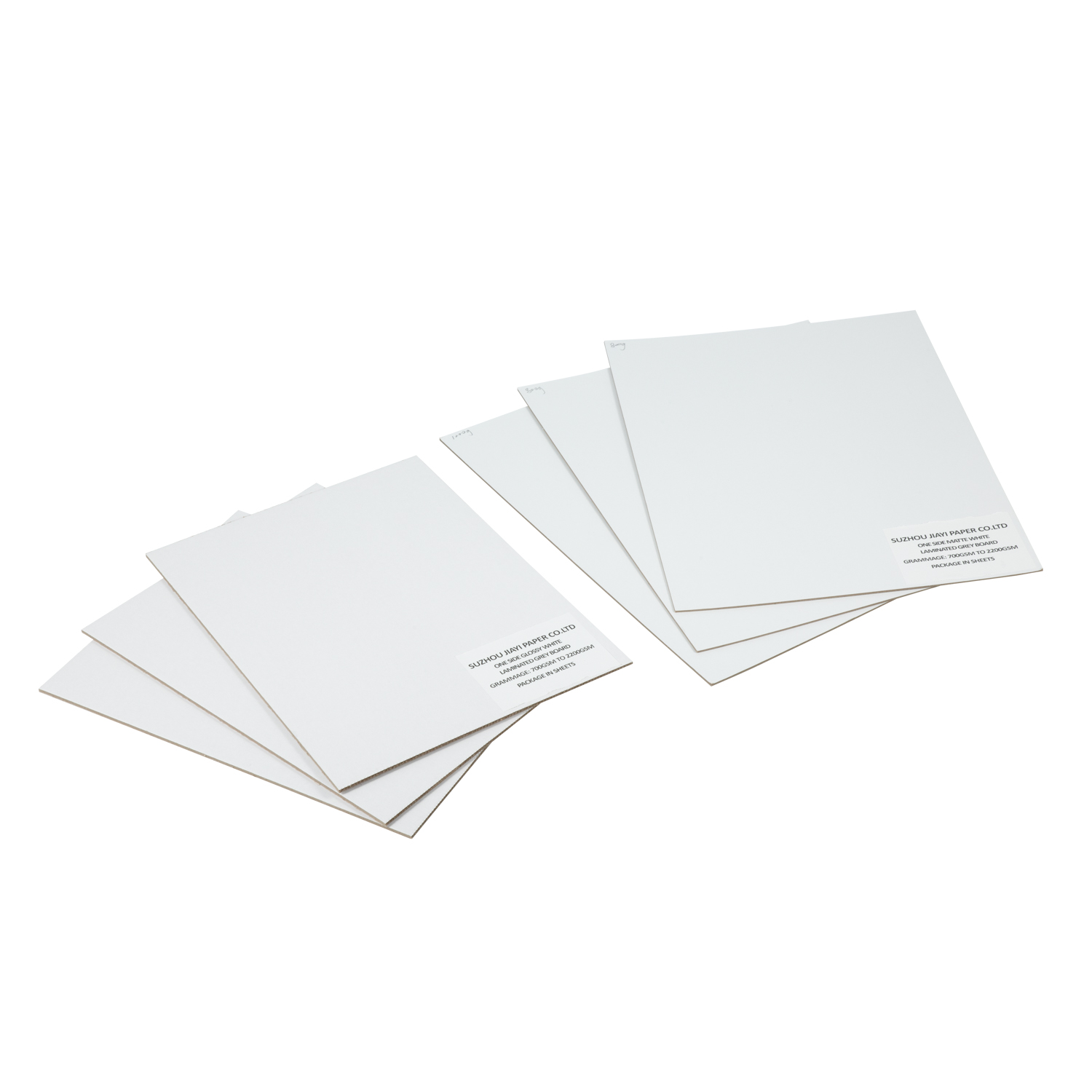
Modern packaging demands materials engineered for specific structural and visual tasks. The multi-layer manufacturing process of composite white grey cardboard addresses these dual requirements directly on the paper machine. The core consists of recycled paper fibers, typically sourced from mixed paper waste and old corrugated containers (OCC). This recycled pulp provides substantial structural bulk and rigidity. Above this robust foundation sits a bleached, coated white top layer. Mills apply a clay coating and run the board through calender stacks to iron the surface flat. This specialized coating ensures high-resolution printability, allowing ink to sit on the surface rather than absorbing into the fibers. You get crisp graphics, vibrant color reproduction, and a surface ready for complex finishing.
The manufacturing process relies on cylinder machines or multi-ply Fourdrinier machines to bond these distinct layers while wet. The hydrogen bonding between the recycled grey plies and the virgin or high-grade recycled white top ply must be strong enough to withstand the mechanical stress of offset printing presses and die-cutting stations. If the internal bond strength is too low, the board will delaminate during processing.
Navigating material procurement requires precise terminology to avoid costly specification errors on the production floor. Single-ply paperboard is generally uniform throughout and lacks the distinct multi-layer strength of composite materials. Standard corrugated fiberboard features a fluted medium sandwiched between liners, prioritizing impact resistance over surface smoothness. Uncoated grey board serves purely structural purposes, lacking the printable white surface entirely.
Industry terminology often causes confusion among buyers and designers. "Grey paperboard" typically refers to thinner, lower-caliper sheets designed for standard folding boxes. Conversely, "grey cardboard" denotes thicker, high-density boards utilized for structural backing, rigid bases, and heavy-duty applications where rigidity is paramount. Knowing the difference between a 300 GSM folding carton board and a 1200 GSM rigid setup box board prevents catastrophic failures on the packaging line.
The unique properties of this material dictate its application across various sectors. You will find it used extensively where presentation and protection carry equal weight. Standard applications include:
Consumer electronics packaging requiring premium unboxing experiences and sharp corner retention.
Cosmetics and pharmaceutical boxes needing pristine print surfaces for regulatory text, barcodes, and high-end branding.
Premium rigid structures where structural integrity cannot compromise visual appeal.
High-end retail displays demanding long-term shelf stability without bowing under humidity.
Software and media packaging that requires a rigid feel to convey product value.
Packaging serves as the primary physical touchpoint for consumers. Assessing surface smoothness and ink holdout is critical for high-end retail environments. The coated surface of composite materials must support advanced finishing techniques without degrading. Foil stamping, deep embossing, and spot UV coating require a stable, non-porous substrate to adhere correctly and maintain sharp edges. If the board surface is too rough, foil will flake and UV coatings will sink into the sheet, destroying the intended gloss effect.
Printers measure surface smoothness using the Parker Print-Surf (PPS) test. Lower PPS values indicate a smoother surface. When evaluating white grey boards, you want a PPS value that guarantees your halftone dots will transfer cleanly from the blanket to the board. Grain direction also plays a massive role here; running the board through the press with the grain parallel to the press cylinders prevents registration issues and sheet distortion.
Retail packaging must survive the journey from warehouse to shelf without deformation. Evaluating edge crush test (ECT) equivalents and burst strength provides baseline data for material performance. Rigidity under retail shelving conditions ensures the packaging does not bow or collapse under its own weight or the weight of stacked products. We measure stiffness using Taber stiffness units. A board with high Taber stiffness will resist bending, keeping the carton square and visually appealing.
Material Type | Surface Smoothness | Taber Stiffness (MD) | Impact Resistance | Primary Application |
|---|---|---|---|---|
White Grey Cardboard | Excellent (Clay Coated) | High | Low to Moderate | Retail Cartons, Rigid Boxes |
Corrugated (E-Flute) | Poor (Washboarding) | Very High | High | Transit, Heavy Retail |
Standard SBS Board | Excellent | Moderate | Low | Lightweight FMCG |
Uncoated Grey Board | Poor (Rough) | Very High | Moderate | Internal Structures |
Environmental compliance dictates modern material selection. Measuring post-consumer recycled (PCR) content and biodegradability provides a clear picture of a material's ecological footprint. The grey core of these composite boards often boasts 100% PCR content, making it a highly sustainable choice. However, the complexities of recycling composite paper packaging require careful navigation. The combination of coated layers, heavy inks, and recycled cores can complicate municipal recycling processes if not properly managed.
Designing packaging with clear recycling labeling is essential. Consumers must easily identify and separate composite paper packaging from standard single-material paperboard in municipal waste streams. Proper iconography and material identification codes mitigate contamination in recycling facilities. Avoid using non-soluble metallic foils or heavy plastic laminations if you want the board to remain fully repulpable.
Material performance on automated packaging lines directly impacts production efficiency. Analyzing how materials handle scoring, folding, and gluing tolerances prevents line jams and excessive waste. High-caliper boards require precise die-cutting equipment and specific scoring matrices to fold cleanly without cracking the coated surface. If the creasing rule is too narrow or the matrix channel too shallow, the white top layer will fracture, exposing the grey core beneath and ruining the carton's appearance.
Glue adhesion is another critical factor. The porous grey back absorbs water-based adhesives quickly, which is excellent for fast setting times on folder-gluers. However, the coated white side requires adhesives formulated to bite through the clay coating. Packaging engineers must test open times and compression times to ensure flaps stay sealed after exiting the compression belt.
Packaging engineers frequently face the dilemma of choosing between retail-ready aesthetics and heavy-duty transit protection. Corrugated materials excel in the supply chain but fall short on the retail shelf due to visible fluting lines. Rigid paperboards look exceptional but lack the shock absorption needed for parcel shipping.
Corrugated fiberboard provides superior impact resistance due to its fluted core. It remains lightweight while offering high stacking strength, making it ideal for transit. However, its uneven surface results in poor smoothness. This "washboard" effect limits detailed lithographic printing capabilities. To get high-end graphics on corrugated, you usually have to print on a separate top sheet and laminate it to the single-face corrugated board—a process known as litho-lamination, which adds significant time and material usage.
Conversely, composite boards deliver exceptional print accuracy and consistent thickness right off the skid. The flat, coated surface allows for flawless graphic reproduction in a single pass on an offset press. The trade-off is the lack of fluting. It cannot provide high-impact drop protection for fragile goods without internal inserts. If you drop a heavy item in a folding carton, the energy transfers directly to the product.
Freight costs play a significant role in material selection, balancing volume versus weight. Using rigid boards for primary packaging often necessitates secondary corrugated shipping containers to ensure safe transit. You have to calculate the dimensional weight of the primary carton and how many units fit into a master shipper. White grey boards are denser than corrugated, meaning a pallet of flat blanks will weigh significantly more, impacting inbound freight logistics.
Determining the necessary thickness and rigidity for consumer goods packaging prevents over-engineering the box. Using materials that are too thick wastes resources and slows down machinery. Materials that are too thin risk product damage, bulging side panels, and brand degradation on the shelf.
Standard paperboard, such as Solid Bleached Sulfate (SBS) or Coated Unbleached Kraft (CUK), is highly flexible. It suits lightweight consumer goods like toothpaste, pharmaceuticals, or cereal boxes. SBS is made from virgin bleached chemical pulp, making it bright white throughout, but it lacks the heavy structural memory required for heavier items. It tears relatively easily compared to denser boards.
Composite boards feature a higher caliper and superior stiffness due to the dense recycled fiber core. This makes them ideal for products requiring a premium unboxing experience or heavier internal weight support, where standard paperboard would bulge or tear. The multi-ply construction gives it a higher tear resistance and better puncture resistance than a single-ply SBS sheet of the same caliper.
Procurement teams must evaluate the cost-to-rigidity ratio. You get more stiffness per point of caliper with a multi-ply recycled board than with a solid virgin board. Additionally, the impact on automated folding machinery speeds must be assessed. Thicker boards may require slower line speeds or specialized folding equipment. You might need to add pre-break sections to your folder-gluer to ensure the heavy scores fold easily on the automated filling line.
Feature | Composite White Grey Board | Solid Bleached Sulfate (SBS) |
|---|---|---|
Core Material | Recycled Mixed Paper (Grey) | Virgin Chemical Pulp (White) |
Stiffness | Very High | Moderate to High |
Machinability | Requires wider scoring matrix | Folds easily at high speeds |
Tear Resistance | High | Moderate |
Regulatory pressure and consumer demand drive a massive market shift away from single-use plastics and non-biodegradable packaging toward fiber-based alternatives. Brands must find materials that offer similar protective qualities, shelf presence, and structural framing without the environmental penalty of traditional plastics.
Plastics like PET and PVC provide an absolute moisture barrier, transparent display options, and high tear resistance. They thermoform easily into custom shapes. Compostable mailers and flexible fiber solutions are ultra-lightweight, minimizing outbound freight costs, but they lack any structural rigidity or protective framing. You cannot stack flexible pouches on a retail shelf without a secondary display tray.
Composite boards offer high structural rigidity and superior eco-credentials. They provide the billboard space needed for branding that flexible pouches lack. However, paper naturally absorbs moisture. To achieve moisture or grease resistance comparable to plastic alternatives, these boards require secondary aqueous coatings, varnishes, or bio-laminations. Uncoated edges will still wick moisture if exposed to standing water.
Brands face the risk of "greenwashing" if the composite board utilizes non-recyclable plastic laminates (like heavy polyethylene films) to achieve barrier properties. This renders the entire package unrecyclable in standard facilities. Mitigating this risk involves specifying aqueous and bio-based coatings that maintain the material's repulpability while providing necessary protection against humidity and handling.
Uncoated grey board serves as the structural skeleton for luxury packaging and publishing. Its dense, recycled composition provides the rigid foundation necessary for high-end presentation boxes, game boards, and structural supports. In a typical setup box, this thick board is scored, folded, and taped at the corners before a thinner, printed text-weight paper is glued and wrapped around it.
Integrating composite materials eliminates the need for separate printed wrap layers in certain mid-tier rigid packaging applications. By utilizing a board that already possesses a printable white surface, manufacturers can print directly onto the substrate, die-cut it, and fold it into a rigid structure. This streamlines production processes, reduces material layers, and cuts down on the adhesive required for wrapping.
In the publishing sector, material specifications are stringent. Evaluating material warp resistance, glue adhesion properties, and longevity is critical for hardcover book covers. The board must remain flat under varying humidity levels. If the moisture content of the board is unbalanced with the cover wrap or the endpapers, the book cover will warp outward or inward. The porous nature of the grey core accepts animal glues and PVA adhesives exceptionally well, ensuring the cover material does not delaminate over decades of use.
Evaluating lead times, minimum order quantities (MOQs), and the global availability of consistent material grades ensures uninterrupted production. Variability in recycled fiber content can affect board stiffness and color consistency from batch to batch. You must establish strict specifications with your mill regarding caliper tolerance, moisture content (typically aiming for 5-7%), and PPS smoothness. Failure to control these variables leads to massive headaches on the printing press.
Delamination presents a significant risk during deep embossing or aggressive die-cutting. If the internal bond of the plies is weak, the coated white layer may separate from the recycled core when the die strikes the sheet. Warping due to moisture sensitivity during transit and storage can severely affect automated line efficiency. If skids of board are unwrapped in a humid plant and left to acclimate improperly, the edges will wave, causing misfeeds and jams in the press feeder.
Analyzing the feasibility of capturing, shredding, and repurposing industrial offcuts creates closed-loop opportunities on the factory floor. Die-cutting generates significant skeleton waste. Utilizing shredded production waste as high-performance, eco-friendly void fill and protective packing material offsets secondary packaging expenditures and reduces landfill waste. Industrial shredders can turn rigid board offcuts into excellent cushioning material for outbound shipments.
Specifying precise moisture content tolerances with suppliers prevents warping issues. Always keep board wrapped in moisture-barrier film until it goes on press. Conducting pilot runs on existing cartoning equipment before full-scale adoption allows engineers to adjust scoring matrices and folding speeds. Test the board with your specific adhesives to ensure fiber tear occurs during the pull test, proving a permanent bond.
Request detailed material specification sheets from suppliers, focusing on caliper, Taber stiffness, and internal bond strength to ensure the board meets your structural requirements.
Order unprinted CAD samples cut on a plotter table to rigorously test structural integrity, corner sharpness, and fold memory under simulated retail conditions.
Conduct a comprehensive trial run on automated folding and gluing lines to verify machinability, adhesive compatibility, and line speed efficiency before committing to large-scale production runs.
Establish strict moisture control protocols in your facility, ensuring pallets remain wrapped until processing to prevent edge waving and registration issues.
A: Grey board is an uncoated, 100% recycled structural board used primarily for internal support and rigid box bases. White grey cardboard features the same recycled core but includes a coated, bleached top layer specifically engineered to support high-quality lithographic printing for retail-facing applications.
A: Grey paperboard generally refers to thinner, lower-caliper sheets used for lightweight folding cartons and standard consumer goods. Grey cardboard refers to thicker, higher-density industrial boards used for structural backing, luxury rigid packaging bases, and heavy-duty applications requiring maximum stiffness.
A: Recyclability depends entirely on the specific surface coatings applied during finishing. Standard clay-coated variations are widely accepted in municipal paper recycling streams. However, versions utilizing heavy plastic laminates for moisture resistance require specialized recycling facilities to separate the layers.
A: No. It lacks the shock-absorbing fluted core found in corrugated cardboard. It is engineered for primary retail packaging and visual presentation rather than secondary or tertiary transit packaging, which requires high impact resistance to protect goods during parcel delivery.
A: Yes. Clean, shredded waste from manufacturing and die-cutting lines can be upcycled as high-quality, eco-friendly packing and void-fill material. This internal recovery process reduces overall packaging spend and improves facility sustainability metrics by keeping waste out of landfills.
A: It performs exceptionally well as a rigid substrate. Its high density resists warping under varying humidity, and its porous recycled core accepts binding adhesives efficiently, making it a standard structural component in the professional bookbinding industry for long-lasting covers.


