
Views: 0 Author: Site Editor Publish Time: 2026-08-15 Origin: Site


For gypsum board manufacturers, paper GSM (Grams per Square Meter) is not just a basic weight metric. It serves as a primary driver of production speed, structural integrity, and final product compliance. Selecting between 140 GSM and 170 GSM directly dictates the balance between material cost-efficiency and premium performance features. These elevated features include critical moisture resistance and rigorous fire ratings. Poor GSM specification leads to costly continuous line stoppages, wasted raw materials, and compromised board quality. This guide breaks down how to evaluate and specify the correct gypsum board paper gsm to match your exact manufacturing requirements. You will learn to navigate the distinct behavioral differences between standard and heavy-weight papers on the production line. Ultimately, we help you avoid expensive production failures by aligning your paper choices perfectly. You will discover practical ways to optimize drying kilns, calibrate tension controls, and ensure your finished drywall consistently meets strict international building codes.
140–150 GSM is the industry standard for lightweight, cost-effective interior drywall, offering faster drying times.
160–170 GSM provides the critical tensile strength required for specialty products, including fireproof gypsum paper and heavy-duty load-bearing boards.
Gypsum liner face and gypsum liner back papers require distinct GSM specifications to optimize the board's structural balance and aesthetic finish.
Evaluating paper strictly by GSM is insufficient; porosity, tensile strength, and Cobb values must align with the chosen weight to prevent delamination.
The manufacturing of drywall relies heavily on precise material specifications. The core business problem often stems from incorrect paper weight choices. Under-specifying your paper GSM directly leads to frequent board breakage. It causes disruptive line stoppages during edge wrapping and scoring. Conversely, over-specifying wastes valuable material spend. It also drastically increases the thermal energy required in the drying kilns. Finding the optimal balance ensures your production line runs at maximum efficiency.
You must understand the structural role of the paper wrap. Drywall is a highly engineered composite material. The inner gypsum core provides essential compressive strength. It resists crushing forces. However, the calcined gypsum core is brittle by nature. The external paper provides the necessary tensile strength. It acts as the tension-bearing element. This prevents the board from snapping when builders bend, carry, or screw it into wall studs. Heavier paper inherently offers more fibers per square meter. These fibers interlock to resist tearing forces.
The dynamics between the front and rear paper layers are equally critical. Manufacturers cannot treat both sides identically.
Face Paper Dynamics: The Gypsum Liner Face requires consistent surface smoothness. It needs a sufficient GSM to prevent the wet slurry from bleeding through during forming. This layer must support later aesthetic surface finishing, including painting and plastering. A robust GSM here prevents unsightly core shadows.
Back Paper Dynamics: The Gypsum Liner Back operates under different mechanical demands. It often utilizes a slightly lower GSM within your acceptable range. It features a rougher texture to enhance structural grip against wall studs. This deliberate difference reduces overall material costs. It effectively maintains the equilibrium of the board, preventing severe warping during the curing process.
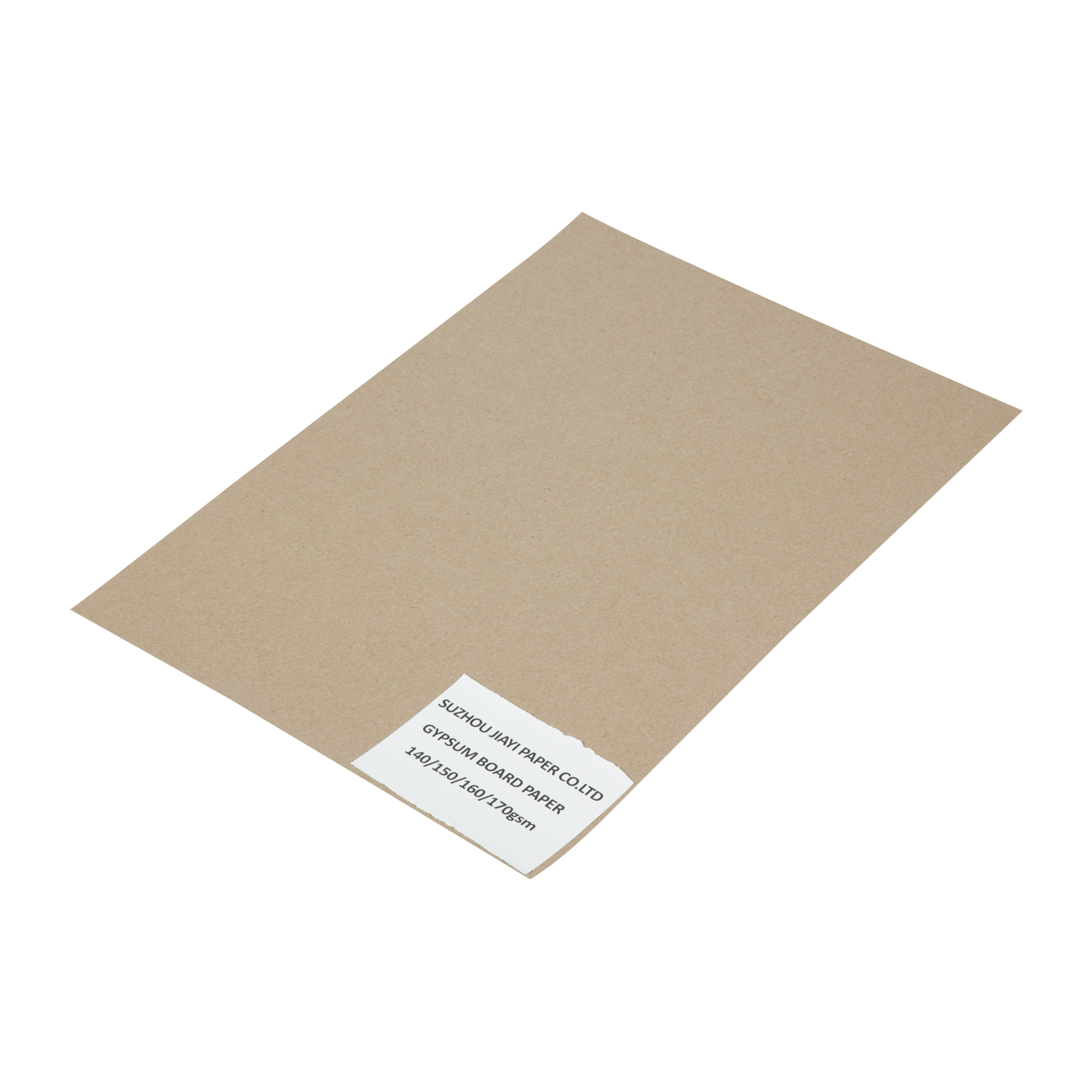
Different product lines require highly specific paper configurations. You must categorize your production runs into distinct performance tiers. This ensures you never under-engineer a premium board or over-engineer a standard partition wall.
This weight range dominates the global drywall market. It represents the baseline for everyday residential and commercial construction. The target outcomes focus heavily on volume and efficiency. Using 140 to 150 GSM paper enables high-speed continuous manufacturing. Lighter paper contains less wood pulp mass. It absorbs less water from the wet slurry. Therefore, you require lower thermal energy in the drying kiln to evaporate residual moisture. Your line can run faster, and your gas bills drop significantly.
The best applications for this tier are standard interior partition walls. You will also use it for standard ceiling boards. These applications typically range from 9.5mm to 12.5mm in thickness. Builders do not expect these standard boards to endure extreme impacts or moisture exposure. They simply need a reliable, cost-effective, and easy-to-cut surface.
Specialty boards demand a much tougher exterior shell. You step up to the 160 to 170 GSM range when performance codes dictate it. The target outcomes include high impact resistance in high-traffic corridors. They also include delayed heat transfer during building fires and extremely low permeability in damp environments.
The best applications in this tier involve highly engineered products. For example, Waterproof Gypsum Paper requires a thicker, denser substrate. This extra mass absorbs and retains specialized hydrophobic chemical treatments. Similarly, Fireproof Gypsum Paper needs this higher mass. The extra fibers help maintain structural integrity during intense heat exposure. They prevent the paper from burning away too rapidly, protecting the fiberglass-reinforced core inside.
However, you face an operational trade-off. Heavier paper traps more water. It insulates the wet core. You must run your line speeds much slower. Alternatively, you must apply higher kiln temperatures. If you fail to adjust your parameters, the board will exit the kiln with severe surface blisters.
Many procurement teams make the mistake of buying paper based solely on its weight. A heavy paper does not automatically guarantee a high-quality product. You must evaluate the raw material using strict engineering criteria. Porosity, strength, and adhesion metrics tell the true story of how the paper will perform.
Paper strength relies on fiber quality, not just fiber volume. A well-manufactured 150 GSM paper from a premium supplier may easily outperform a poorly pulped 170 GSM paper. You must evaluate the breaking length and bursting index. Always check the MD/CD ratio. MD represents the Machine Direction. CD represents the Cross Direction. If the cross-direction strength is too low, the paper will split laterally during the scoring and folding stages. A balanced strength profile ensures smooth continuous wrapping.
Porosity measures how easily air and steam pass through the paper matrix. It is absolutely critical for the drying phase. The GSM must never compromise the paper's ability to allow steam to escape the hot gypsum core. When wet drywall enters the kiln, water turns to steam rapidly. If you use a highly dense, low-porosity paper, it traps the steam. The immense pressure inside the board will cause catastrophic "blowouts." The paper will literally tear off the core. Always demand Gurley porosity test results from your supplier.
You must control how much water the paper absorbs. This is especially true when evaluating Gypsum Board Paper for damp environments. You verify this using the Cobb60 value. This test measures the amount of water absorbed by a square meter of paper in 60 seconds. The paper weight must work in tandem with internal hydrophobic additives. If a heavy paper has a poor Cobb rating, it will soak up water like a sponge. This leads to sagging boards and rapid mold growth on job sites.
The paper must stick to the gypsum core permanently. Heavier GSM papers, particularly those hitting 170 GSM, sometimes feature highly dense calendering. Calendering is the pressing process used to make paper smooth. While this creates a beautiful finish, it can seal the pores too tightly. This smooth surface aggressively resists the starch-based adhesives mixed into the gypsum slurry. The slurry cannot penetrate the paper fibers. You must verify ply-bond strength through pilot tests. Ensure your adhesive formulation can penetrate the dense surface of heavy-weight liners.
Gypsum Paper Performance Parameters Comparison
Specification Metric | 140-150 GSM Standard | 160-170 GSM Premium | Primary Production Impact |
|---|---|---|---|
Porosity (Gurley sec/100ml) | Lower (Highly breathable) | Higher (Less breathable) | Dictates kiln speed and prevents steam blowouts. |
Tensile Strength (MD/CD) | Adequate for standard use | Exceptional multi-directional | Prevents web breaks and improves edge wrapping. |
Cobb60 Value (Water Absorption) | Moderate to High | Strictly Low (Treated) | Determines moisture resistance in final application. |
Calendering & Adhesion | Standard porosity, easy bonding | Dense surface, requires optimized starch | Prevents long-term delamination and peeling. |
Upgrading your line to produce premium boards carries mechanical risks. You cannot simply load a heavier roll of paper onto the machine and press start. Transitioning from 140 GSM to 170 GSM demands strict operational recalibration. Failing to adapt your machinery will destroy your yield rates.
Heavier paper behaves very differently on the unwind stands. Switching to 170 GSM requires immediately adjusting your web tension controls. The mass of the roll is greater. The rotational inertia increases. If your braking system applies the same tension used for 140 GSM, the heavy paper will snap. Web breaks halt the entire factory line. They force operators to manually re-splice the rolls. You must calibrate load cells to accommodate the stiffer, heavier material smoothly.
The drying kiln represents the largest bottleneck in transition. Heavier paper retains significantly more moisture from the slurry. It acts as an insulator. Operators often attempt to compensate by indiscriminately spiking kiln temperatures. This creates a massive risk of core calcination. If the outside gets too hot before the inside dries, the gypsum core dehydrates completely. It turns back into useless dust. You must carefully step up the temperature zones. You need a prolonged, gradual drying profile, not a sudden blast of extreme heat.
The edges of a drywall panel are highly vulnerable. The folding equipment wraps the face paper around the edges to meet the back paper. Thicker 170 GSM paper possesses much higher stiffness. It resists folding.
You must recalibrate the scoring wheels to cut slightly deeper into the heavy paper.
You must adjust the folding guides to apply slightly more mechanical pressure.
You must increase the moisture at the edge-wetting station to soften the rigid fibers.
If you skip these recalibrations, you will experience micro-cracking at the board edges. The stiff paper will simply snap instead of bending smoothly around the 90-degree corners.
Sourcing high-quality paper requires rigorous technical vetting. You cannot rely on marketing brochures. You must demand hard data, run physical trials, and verify international compliance. This ensures your final product remains safe, durable, and fully certified for construction use.
Do not accept generic claims from a supplier offering "150 GSM" paper. GSM varies naturally during the pulp rolling process. You must demand precise technical data sheets showing exact manufacturing tolerances. A trustworthy supplier will guarantee a tight tolerance, such as 150 GSM ± 3%. Wide tolerances mean one part of the roll might be 140 GSM while another part is 160 GSM. This inconsistency will ruin your continuous board thickness and destabilize your kiln parameters.
Laboratory testing alone is inadequate. You must mandate a minimum roll-length trial on your actual production line. Run a full master roll at normal operating speeds. You need to test continuous runnability under real tension. You must test joint splicing reliability. A heavier 170 GSM paper might cause your automatic splicer to fail if the tape cannot hold the extra weight. Finally, you must measure real-world kiln drying times to calculate your actual energy consumption per board.
The construction industry relies on strict safety standards. You must look for suppliers who provide comprehensive batch-level testing data. They should offer complete traceability for both face and back liners. Their internal testing must align with recognized global frameworks. Ensure the paper helps your final product maintain compliance with ASTM C1396 standards in North America or EN 520 standards in Europe. This proven authoritativeness protects you from liability and rejection by building inspectors.
Choosing between 140 and 170 GSM is a highly calculated engineering decision. It requires balancing material costs against structural strength and environmental demands. Standardizing on 140 to 150 GSM for your high-volume production maximizes operational speed and preserves healthy margins. Conversely, you should strategically reserve validated 160 to 170 GSM stock for premium architectural boards. This includes fire-rated partitions and moisture-resistant panels.
Your immediate next step should involve an internal supplier audit. Initiate supplier evaluation by requesting a side-by-side TDS comparison between their standard and heavy-weight offerings. Focus your attention heavily on the porosity figures and the MD/CD tensile strength ratios. Conduct a pilot run to adjust your edge-folding equipment. By mapping out these precise calibration steps, you will drastically reduce waste and deliver a superior, fully compliant drywall panel to the market.
A: Yes, but it is not cost-effective. Manufacturers typically use a slightly heavier, smoother paper for the face (e.g., 160 GSM) and a lighter, highly porous paper for the back (e.g., 140 GSM) to optimize cost and drying efficiency.
A: No. While higher GSM (160+) provides better structural integrity during a fire, true fireproof gypsum paper also requires specific chemical retardant treatments and a fiberglass-reinforced gypsum core.
A: Likely due to low porosity. Thicker paper can trap steam inside the board during baking. If the steam cannot escape through the paper, it breaks the adhesive bond, causing delamination or "blistering."
A: While it varies by supplier, a reliable industrial standard is a GSM tolerance of ±3% to ±5%, ensuring consistent web tension and board thickness.


