
Views: 0 Author: Site Editor Publish Time: 2026-05-29 Origin: Site


Miscalculating board thickness often leads to disastrous packaging outcomes. Choosing the wrong core material creates delamination and severe edge curling. These physical failures inevitably damage your brand perception in premium markets. You need reliable structural solutions today. Modern brands demand sustainable, high-rigidity materials. These boards must support luxury finishes perfectly. They should achieve this without the heavy environmental burden of virgin fibers. Our comprehensive guide offers a technical evaluation framework. B2B buyers will learn how to specify materials accurately. We will help you source and apply these core boards for various structural applications. By understanding exact industry standards, you can optimize your entire procurement process. Discover how these versatile materials elevate your modern packaging designs.
Laminated grey board is categorized by caliper (thickness in mm/microns) and weight (GSM), not standard paper weight metrics.
Industrial-grade multi-ply laminated grey board requires strict moisture balance during manufacturing to prevent warping in post-production.
Its primary advantage over corrugated board is superior bending stiffness and long-term compression strength for stacking.
Applications range from high-end rigid boxes and book binding to specialized uses like e-commerce subscription inserts and flooring backings.
Understanding material composition is the first step in successful procurement. Factories manufacture composite grey board using 100% recycled paper. The raw input consists mainly of old newspapers and corrugated offcuts. Pulpers break down these fibers completely. Giant industrial machines then press this pulp into dense, flat sheets. This closed-loop recycling process creates an incredibly robust substrate. It diverts massive waste volumes from landfills annually.
Buyers often confuse industry terminology. Standard single-ply chipboard is relatively thin and flexible. It serves basic needs. Conversely, laminated grey board involves gluing multiple layers together under pressure. This specific multi-ply construction engineers superior rigidity. It prevents bowing under heavy loads.
You must master measurement standards to specify orders correctly. Standard paper uses basic weight metrics. Heavy boards use different, precise jargon. Professionals measure thickness in calipers (millimeters). You will also see specifications in Microns ("Mics" or µ). Density relies heavily on GSM (Grams per Square Meter). Knowing the relationship between Microns and GSM prevents costly specification errors.
An interesting aesthetic shift is transforming the packaging industry. Brands historically hid the grey core under glossy printed wraps. Today, an eco-minimalist "No Frills" trend prevails. Modern companies utilize the unfinished, neutral grey background proudly. It acts as a powerful brand asset. Exposing the raw material signals environmental responsibility directly to consumers.
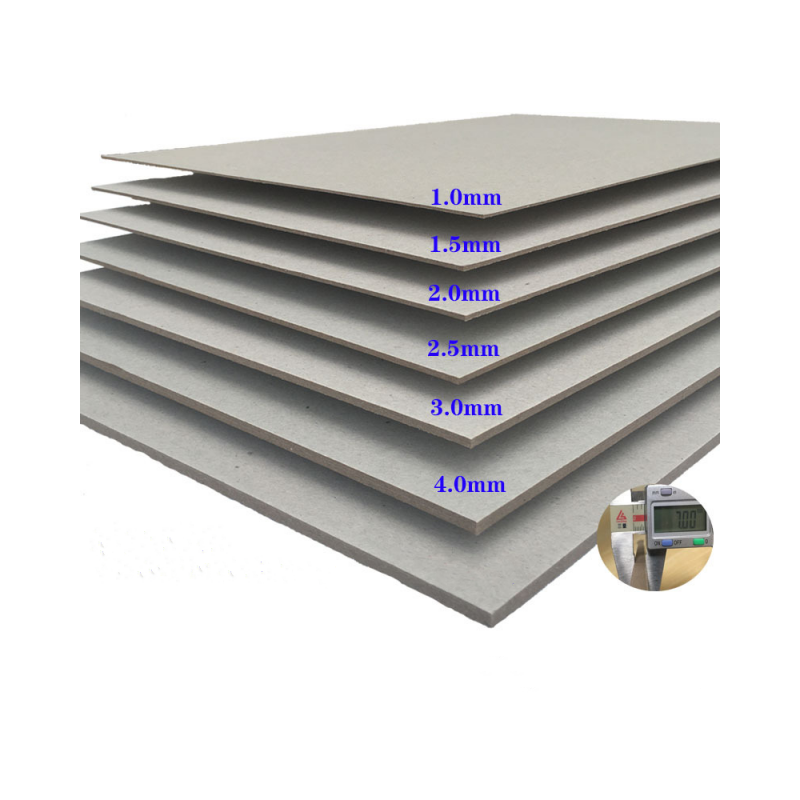
Manufacturing realities dictate the final quality of your packaging. Producing premium heavy-duty cardboard requires extreme precision. Massive industrial rollers apply immense force during production. They press the wet pulp at pressures reaching up to 200 tons per square meter. This intense pressure achieves uniform density across the entire sheet. Uniformity prevents weak spots.
Moisture control remains a critical factor. Reliable suppliers manage moisture balance tightly throughout production. Uneven moisture causes severe warping later. You will notice this warping immediately when applying wet adhesives during post-production. A properly stabilized multi‑ply laminated grey board maintains structural integrity perfectly. It resists environmental humidity fluctuations.
To simplify procurement, we created a practical evaluation matrix. Use this cheat sheet to align your project requirements with the correct material specifications.
This material forms the primary base for luxury retail packaging. High-end smartphones and fine jewelry require absolute protection during transit. Packaging designers rely on high-density gift box board for these high-stakes projects. It serves as an incredibly reliable rigid box board. The smooth edges create perfect right angles for premium presentation.
Trend integration shows rapid growth in online retail. E-commerce subscription boxes heavily utilize these boards. Brands insert customized protective dividers inside mailers. These structural inserts elevate the unboxing experience dramatically. Superior unboxing aesthetics directly drive customer retention and social media sharing.
The commercial printing sector consumes massive volumes globally. Hardcover books and durable ring binders depend entirely on this core material. Premium puzzle boards also require tight manufacturing tolerances. We frequently see its widespread use as stationery board. It provides the necessary heft for luxury notebooks.
It excels remarkably in Point-of-Sale (POS) displays. POS retail materials require high surface smoothness. Smooth surfaces allow for direct digital or offset printing. They also support mounting vibrant promotional artwork flawlessly. A rigid backing ensures the display stands tall throughout a seasonal retail campaign.
Applications extend far beyond standard packaging board. The agricultural sector uses it creatively for daily operations. Farmers utilize treated boards for temporary seedling trays. Construction teams deploy it for temporary weather-protection panels on job sites.
It even supports home interior manufacturing. Flooring producers use it as a structural backing layer. It stabilizes carpets and laminate flooring effectively. This adds acoustic dampening and physical rigidity to the final flooring product.
Buyers frequently debate between these two ubiquitous materials. Corrugated board utilizes trapped air and flutes. This structure makes it highly vulnerable to crushing. Long-term warehouse stacking often damages corrugated cartons permanently. Conversely, grey laminated board offers solid, uniform crush resistance. It bears heavy vertical loads without buckling.
You must analyze bending stiffness for premium projects. This trait remains essential for luxury packaging production. Dense thick paperboard maintains sharp, 90-degree V-groove folds. It accomplishes this without collapsing under machinery pressure.
Surface tension and lamination present another major difference. Corrugated fluting frequently causes a defect known as "washboarding". This leaves visible vertical lines on the outer wraps. Grey boards provide a perfectly flat, solid substrate. This smooth surface welcomes complex UV coatings. It supports matte or gloss laminations seamlessly. Foil stamping also applies crisply on a solid core.
Review this comparison chart to understand the key performance metrics:
Performance Metric | Laminated Grey Board | Corrugated Board |
|---|---|---|
Compression Strength | Excellent. Withstands long-term warehouse stacking without structural failure. | Moderate. Flutes can crush under sustained vertical pressure. |
Bending Stiffness | High. Perfect for sharp V-grooves and crisp 90-degree folds. | Low to Moderate. Folds can appear rounded or bulky. |
Surface Smoothness | Superior. Flat surface ideal for mounting, foil stamping, and laminating. | Poor. Prone to "washboarding" where underlying flutes show through. |
Weight Profile | Heavy and dense. Imparts a luxury feel to the end product. | Lightweight. Ideal for cheap shipping logistics. |
You must address sourcing risks proactively to protect your supply chain. Warn your purchasing teams against abnormally cheap composite boards. Low-quality boards frequently suffer from delamination. The internal layers split apart due to poor-quality adhesives. Inadequate pressing during manufacturing also causes this fatal splitting. When delamination occurs, your entire packaging run becomes unusable.
Discuss machinery compatibility with your production team. You can cut board under 1mm easily using standard rotary cutters. However, thicker boards present distinct mechanical challenges. Processing anything over 1.5mm requires commercial guillotines. You will need heavy-duty die-cutting machines to ensure clean edges. Frayed edges ruin the aesthetic of premium boxes.
Establish a strict shortlisting logic for new vendors. Advise procurement teams clearly on technical requirements.
Request specific GSM tolerances from potential suppliers (e.g., +/- 3%).
Demand exact moisture content guarantees before signing contracts.
Request physical samples to test adhesive compatibility in your facility.
Verify the manufacturer uses climate-controlled storage for their finished inventory.
Common mistakes often derail projects early. Buyers sometimes specify GSM without dictating a caliper range. Because recycled fibers vary slightly, 1200 GSM from two different factories might yield slightly different thicknesses. Always specify both metrics on your purchase orders.
Selecting the right core material fundamentally dictates your product's success. It requires a careful balance of physical parameters against end-user presentation. Caliper and GSM metrics define the material's actual performance on the factory floor. Keep these actionable next steps in mind as you refine your procurement strategy:
Audit your current packaging fail rates today. Check specifically for warped lids, crushed corners, or peeling wraps.
Use this audit data to justify necessary material upgrades. Higher-density, multi-ply boards resolve most structural failures instantly.
Update your vendor scorecards to include moisture content guarantees and strict GSM tolerances.
Explore eco-minimalist designs that expose the raw board to boost your brand's sustainability narrative.
A: Not inherently, as it is made from recycled materials. However, it is widely used in indirect food packaging when lined with a barrier like PE-coated paper (e.g., cake boards).
A: They are often used interchangeably in the industry, but "chipboard" typically refers to thinner, unlined stock, whereas "laminated grey board" implies thicker, multi-ply construction engineered for rigidity.
A: Only for short-term use. The material is highly absorbent and will degrade in wet conditions unless treated with heavy waterproof laminations.


